How can I handle too many customer messages online?
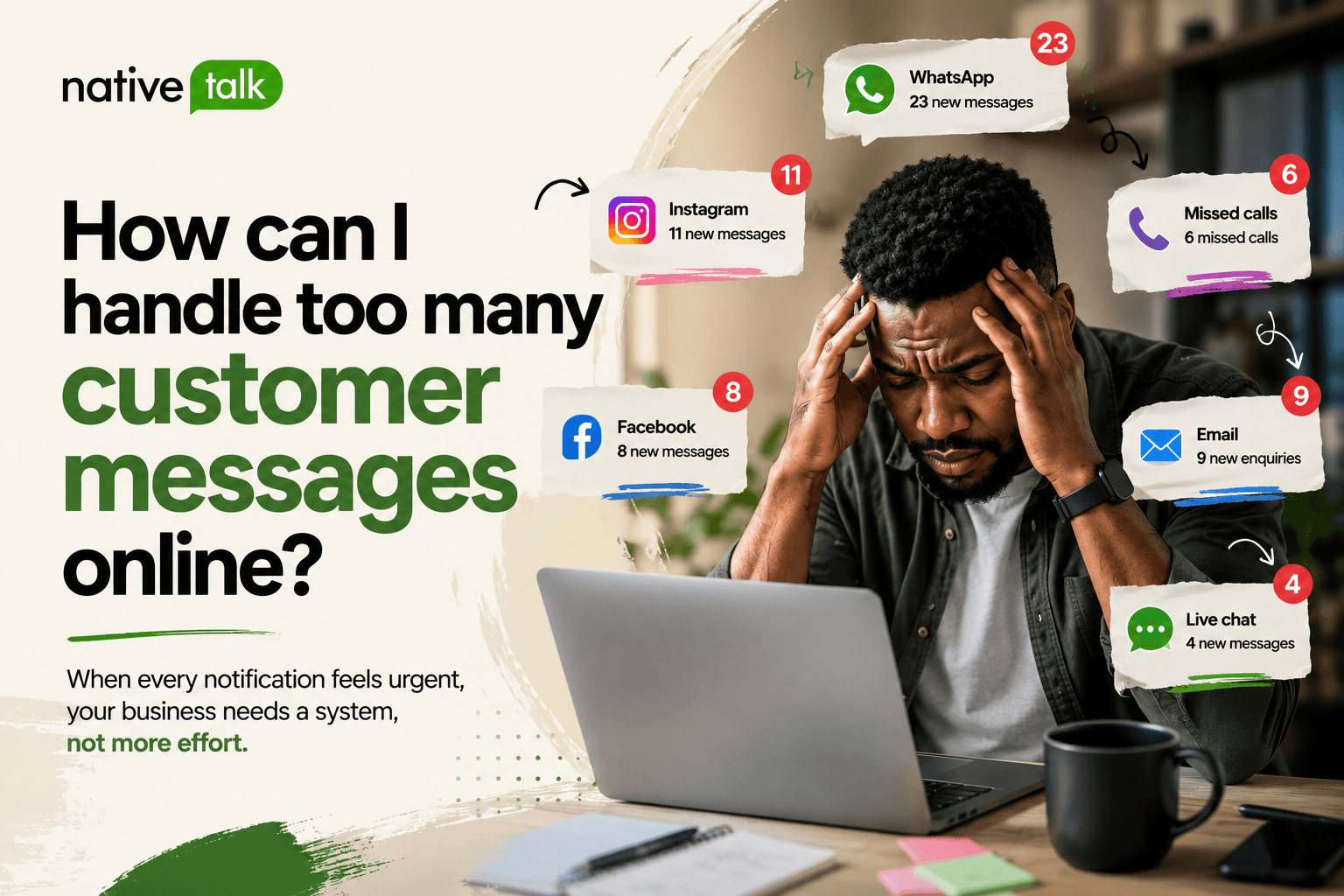
There comes a point in every growing business where the notifications stop feeling like good news.
WhatsApp is buzzing.
Instagram DMs keep coming in.
Facebook messages pile up.
Customers are calling while your team is still replying to yesterday's enquiries.
At first, it feels like growth.
Then it starts to feel overwhelming.
You aren't ignoring customers because you don't care.
You're simply trying to keep up.
The real question isn't how to answer more messages.
It's how to stop managing customer conversations one notification at a time.
More Messages Usually Mean One Thing
Your business is growing.
That's a good problem to have.
More enquiries mean more people are interested in what you offer.
But growth also exposes the systems you've been relying on.
The WhatsApp account that worked when you had ten enquiries a day suddenly struggles with one hundred.
One team member becomes responsible for every reply.
Important messages disappear under newer ones.
Customers follow up because nobody responded.
Your team spends more time looking for conversations than actually helping customers.
The problem isn't the number of messages.
It's the way they're being managed.
Why Businesses Fall Behind
Most businesses don't have too many customers.
They have too many disconnected conversations.
A customer sends a WhatsApp message.
Then they call.
Later they send an Instagram DM.
Another team member replies through Facebook.
Nobody has the full picture.
So the customer repeats themselves.
The team repeats work.
Time gets wasted.
When communication is spread across different apps and devices, every new enquiry creates more confusion.
The Hidden Cost of Message Overload
Customers don't always complain about slow replies.
Most simply move on.
The opportunity disappears before you even know it existed.
Your team feels busy all day.
But being busy isn't the same as being productive.
The longer your team spends switching between apps, forwarding screenshots, or asking who replied to a customer, the less time they spend building relationships.
That's where revenue starts leaking.
Not because customers stopped buying.
Because your business couldn't keep up with the conversation.
Hiring More People Isn't Always the Answer
Many business owners assume they need more staff.
Sometimes they don't.
Sometimes they just need better visibility.
Imagine if every customer conversation lived in one place.
Every team member could see previous chats.
Calls and messages stayed connected.
Nothing depended on one person's phone.
Now your team spends less time searching and more time responding.
That's what good communication systems do.
They remove friction.
The Goal Isn't to Reply Faster
It's to make sure no customer is forgotten.
Fast replies matter.
But consistency matters even more.
Customers want to know that when they contact your business, someone will respond, follow up, and remember the conversation tomorrow.
That doesn't happen through harder work.
It happens through better systems.
Build a Business That Can Handle Growth
Every growing business reaches a point where personal phones and scattered conversations no longer work.
The businesses that continue growing don't rely on memory or manual follow-ups.
They build communication systems that grow with them.
Platforms like NativeTalk bring calls, WhatsApp, customer history, and team collaboration into one shared workspace, making it easier to manage every conversation without losing the personal touch.
Because the challenge isn't having too many customer messages.
The challenge is having nowhere to manage them.rts with a conversation that never got a reply.
