Signs Your Business Has Outgrown WhatsApp, and how it’s affecting you
Your business outgrew WhatsApp months ago, but nobody told you
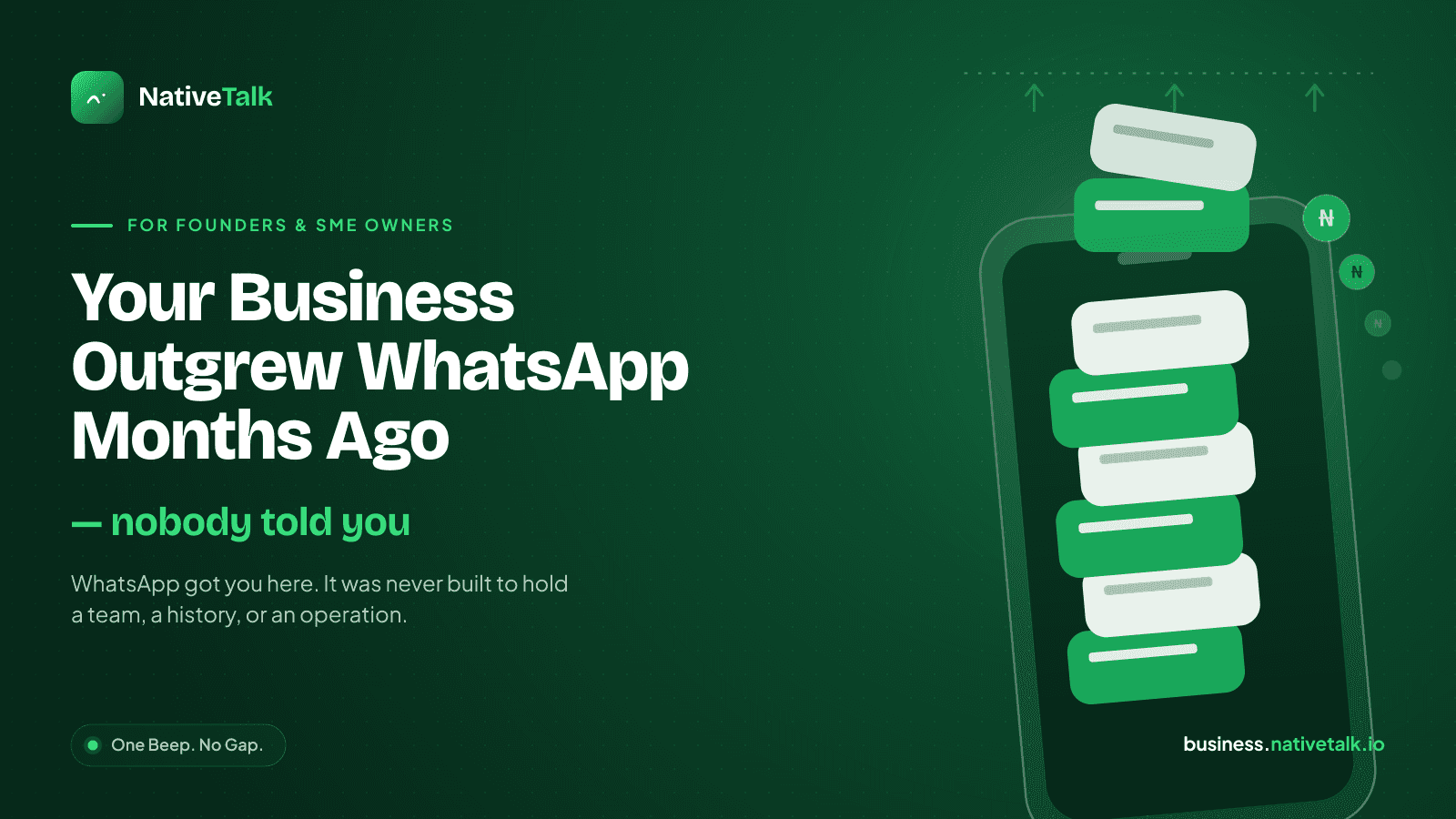
WhatsApp built your business. This is the moment to notice it has quietly started holding it back, and what graduating actually looks like.
Picture this: a customer calls your office, already upset. She was promised a refund three days ago over WhatsApp. But the staff member who made that promise is on leave, and the conversation is on her personal phone, which is with her, wherever she is. Nobody else can see it. Nobody knows what was agreed. So the customer tells her story again, from the beginning, to a third stranger, getting angrier with each sentence, while your business looks disorganised through no fault of the person currently on the call.
That is usually the moment. The founder sits back and realises: we have three staff, three phones, three different WhatsApp accounts, and no single picture of what is happening with our customers. It is a moment that arrives in every growing business, from boutiques in Lekki to distributors in Onitsha. The instinct is to blame the tool. But WhatsApp did not fail. It was simply never built for the job it had quietly been handed.
WhatsApp didn't fail you. You graduated.
Let us be fair to the app that got you here. For a new business, WhatsApp is close to perfect. Customers already live on it, it costs nothing, and there is no setup and no learning curve. One founder can run an entire customer base from a single phone, and it feels personal because it genuinely is. Nobody should feel foolish for starting there. In Nigeria, starting anywhere else would be strange.
The mistake is not using WhatsApp. The mistake is assuming the tool that carried you from zero to your first thousand customers can also carry you from one thousand to ten, when it was never designed to hold a team, a history, or an operation. The tool did not get worse. Your business got bigger than the tool.
Real scenario: "A food business in Lagos grew from 20 orders a week to 200. Same WhatsApp, same phone, same founder answering at midnight. The product was scaling; the communication was not. Customers began describing the brand with a word nobody had ever used before: 'unserious.' Nothing about the food had changed."
Where the seams show
The constraints do not arrive gradually. They show up all at once, usually on a busy day, and they are structural rather than fixable. Customer relationships sit on phones and accounts the business does not own. Conversations split across private accounts mean no one ever sees the full picture. There is no memory tied to the customer (who she is, what she bought, what she was promised), only an endless scroll. There are no metrics, so there is nothing to manage. And when someone is sick, on leave, or gone for good, their conversations are simply unavailable.
3 separate staff accounts, each holding fragments of your customer relationships 0 shared view of what has been said, sold, or promised. 1 unanswered chat is all it takes for a customer to try your competitor
The five lessons
A chat app stores chats. A business needs memory. WhatsApp remembers messages; it does not remember customers. It cannot tell you who this person is, what she ordered in March, or what your colleague promised her last week. A growing business runs on exactly that kind of memory, and a chat thread is where memory goes to get buried.
If it lives on a personal phone, the business doesn't own it. Every customer relationship conducted through a staff member's personal account belongs, in practice, to that staff member. The day she leaves, or just travels, the relationship leaves with her. A business that does not control its own conversations is renting its customer base.
No metrics means no management. How fast does your team reply? How many conversations went unanswered this week? On personal chat accounts, these questions have no answers, and what cannot be measured cannot be improved. You are not managing customer experience. You are hoping for it.
Handover is impossible when history is private. One staff member on leave should be a calendar event, not a customer service crisis. When conversation history is locked in private accounts, every absence forces customers to start from zero, and tells them, each time, that your business cannot remember them.
Outgrowing your tools is a milestone, not a failure. Hitting WhatsApp's ceiling means the strategy worked: you grew. The businesses that stall are not the ones that outgrow their tools. They are the ones who notice and do nothing, running a ten-person operation on infrastructure built for a chat between friends.
"The tool didn't get worse. Your business got bigger than the tool, and that was always the goal."
What graduating to a business communication platform actually means
Graduating does not mean abandoning the channels your customers love. Nigerians are not leaving WhatsApp, and neither should your business. Graduating means putting a customer communication platform underneath those channels, one that the business owns, where every WhatsApp message, Instagram DM, Facebook message, call, and email lands in a single shared place, attached to the customer it belongs to, visible to the whole team.
For the customer, nothing changes. She still chats with you on the app she loves, in the casual tone she prefers. For the business, everything changes. There is no history, accountability, handover, or numbers. The conversation stays warm on the surface and becomes serious infrastructure underneath. That is the difference between a business that is improvising and one that is built to scale.
The shift: "Graduating doesn't mean leaving WhatsApp. It means WhatsApp stops being the system, and becomes one doorway into a system your business actually owns."
The cost of waiting
Every week this decision waits, the pile of customer history locked inside personal accounts grows, and so does the cost of the day it disappears. The refund dispute, the staff departure, the lost phone: one of them is coming, because one of them always comes.
The businesses that scale gracefully are the ones that recognised the graduation moment for what it is, not a crisis but a milestone, and built the system before they desperately needed it.
You have already outgrown the tool. The only question is how long you keep paying for it.
Introducing NativeTalk Business App Keep WhatsApp. Add the system underneath it. NativeTalk Business App doesn't take you away from the channels your customers love. It brings your WhatsApp, Instagram DMs, Facebook messages, calls, and email into one shared system your whole team can work from, with full conversation history, a dedicated business hotline, and AI-powered summaries. The chat stays casual. The business behind it becomes serious. Get Free access → business.nativetalk.io
