Your Employees Are Using Personal WhatsApp for Customer Communication. Here's Why That's a Serious Business Risk
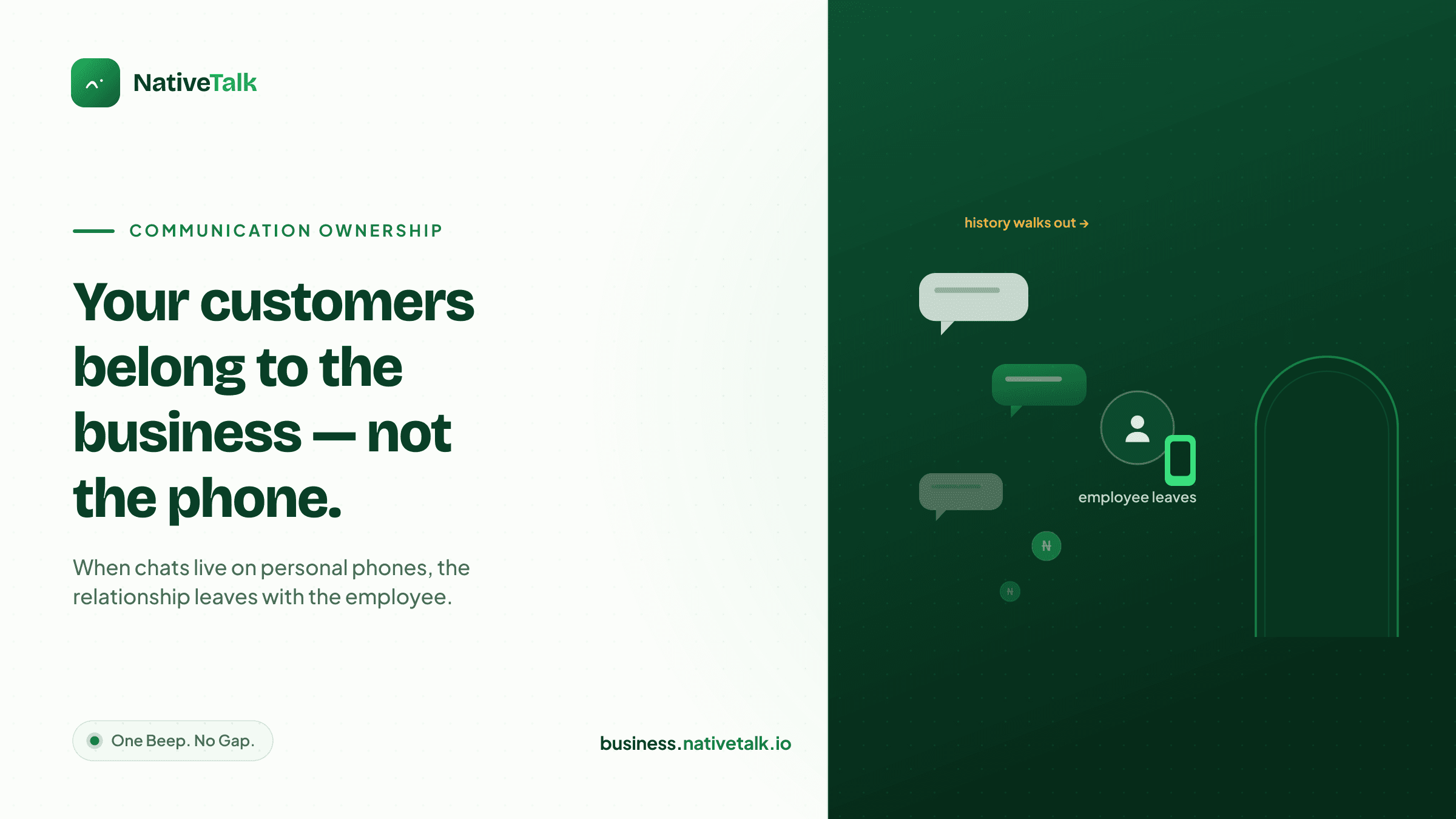
A customer places an order via WhatsApp.
An employee responds.
The customer follows up days later.
Another update is sent.
Then the employee resigns.
The entire conversation history — pricing agreements, commitments, complaints, and support details — disappears with them. The business loses the relationship, the context, and the record.
This scenario plays out daily in many Nigerian businesses. Customer communication has quietly shifted to personal WhatsApp accounts, private phone numbers, personal emails, and individual social media profiles. What feels convenient is actually a major operational vulnerability.
Businesses invest heavily in acquiring customers, but often leave one of their most valuable assets — customer conversations — completely outside their control.
The real issue isn’t WhatsApp itself.
It’s communication ownership.
The Rise of Informal Business Communication
Today’s customers demand instant responses. Remote work and multi-channel engagement have pushed many teams to rely on personal messaging apps for speed. Employees commonly use:
- Personal WhatsApp accounts
- Private mobile numbers
- Personal emails
- Unofficial social media profiles
While these tools help in the moment, they create long-term risks when used for official business.
Why Businesses Lose Control of Customer Relationships
Customer relationships are built through conversations — inquiries, quotations, complaints, follow-ups, and negotiations. When these happen on personal devices, businesses lose:
- Visibility: Leaders and managers cannot see communication history or monitor service quality.
- Continuity: New team members or replacements start from zero, forcing customers to repeat themselves.
- Knowledge Retention: Critical business intelligence walks out the door with every departing employee.
The result? A fragile operation that depends on individuals rather than systems.
The Hidden Risks of Personal WhatsApp for Business
The dangers go far beyond employee turnover:
Customer Data Leaves the Company
Names, preferences, purchase history, complaints, and negotiation details remain trapped on personal phones — outside company systems and security protocols.
No Audit Trail or Accountability
Disputes over promises, refunds, or agreements become impossible to verify. Businesses are forced to rely on memory instead of evidence.
Inconsistent Customer Experience
Customers receive fragmented service. Without shared history, every interaction feels like starting over, damaging trust and satisfaction.
Compliance and Legal Exposure
Data protection regulations and audit requirements are harder to meet when records are scattered across personal devices.
Lost Organizational Knowledge
Vacations, role changes, or turnover repeatedly erase valuable context, slowing operations and hurting performance.
Why Official Communication Channels Matter
Mature, scalable businesses understand a simple rule: Important conversations belong in official systems.
Official channels — whether business phone systems, dedicated communication platforms, or unified CRMs — deliver structure, accountability, transparency, and continuity. They protect both the organization and its employees.
Documentation isn’t bureaucracy. It’s business continuity.
Office WhatsApp Groups Are Not a Real Solution
Many businesses try to fix the problem by creating company WhatsApp groups. While useful for quick internal chats, they fall short as a primary communication system:
- Poor searchability and organization
- Limited oversight and reporting
- Difficult handovers when staff change
- No unified customer view
- Weak audit capabilities
As your business grows, these limitations become expensive.
The Future Is Centralized Communication
Leading organizations are moving to unified platforms that bring customer interactions, team collaboration, and records into one secure environment — creating a single source of truth.
How NativeTalk Helps You Regain Control
NativeTalk was designed specifically to solve fragmented communication in businesses like yours. It unifies customer conversations (WhatsApp, calls, email, social) with internal team collaboration in one powerful platform.
With NativeTalk, you can:
- Keep all customer communication records inside the business
- Give teams full visibility into conversation history and context
- Improve response times and service consistency
- Strengthen accountability and monitoring
- Protect customer relationships during staff changes
- Reduce operational risk and compliance gaps
Your Customers Belong to the Business, Not the Phone
Customer acquisition is important, but customer retention and relationship ownership determine sustainable growth. When conversations live on employee devices, you’re not building a business,you’re renting access to your own customers.
The question isn’t whether your team uses WhatsApp.
The question is whether your business owns the customer relationship.
Don’t let personal messaging put your hard-earned customer relationships at risk. Centralize your communication with NativeTalk and turn every conversation into a lasting business asset.
