Your Missed Calls Are Costing You Thousands (Here's How to Fix It)
The most expensive call your business ever received is the one nobody answered.
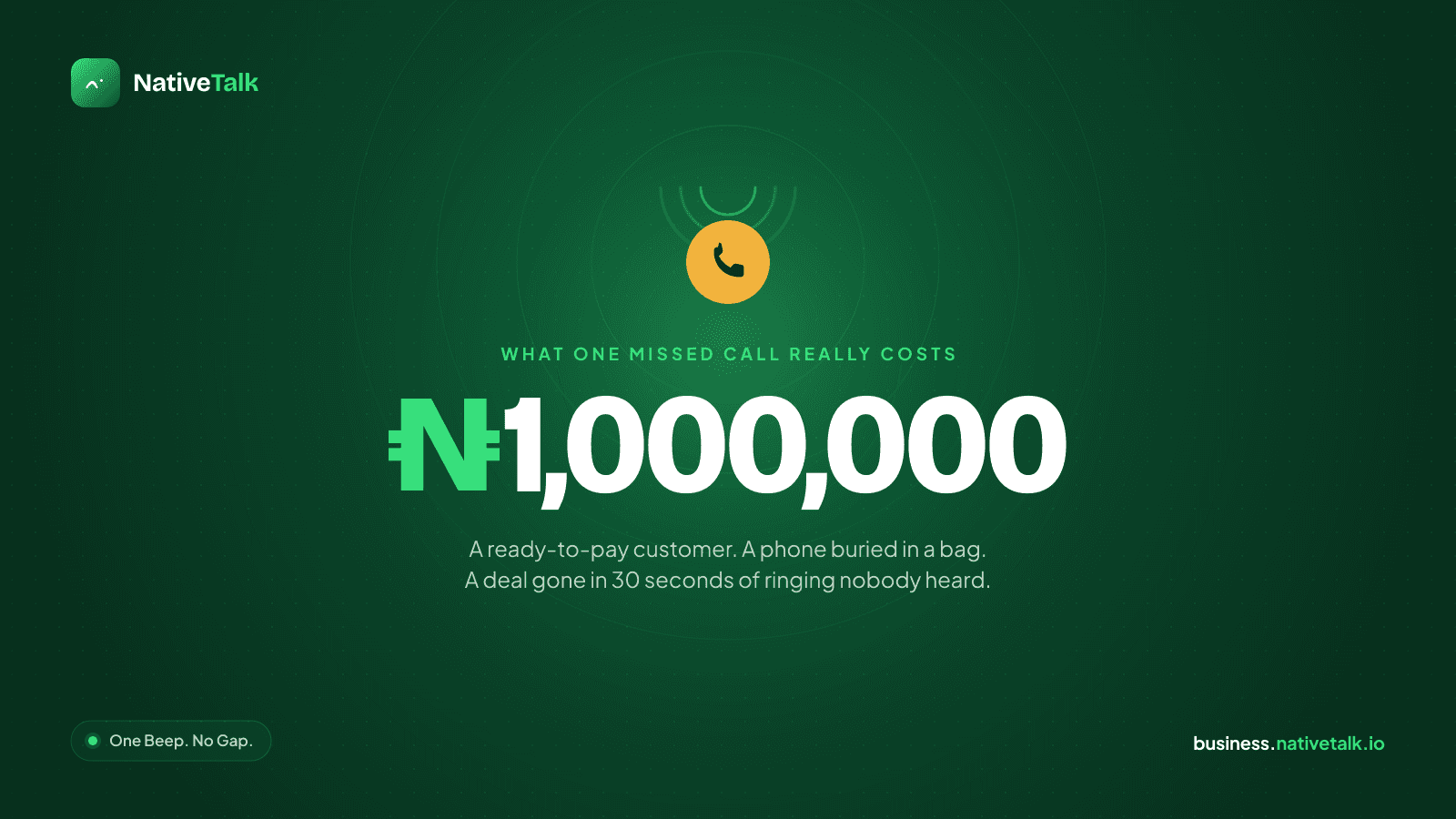
Every business has a missed call log. Almost nobody treats it as what it really is: a record of revenue that walked away in silence.
Picture this: it is a Tuesday afternoon in Lekki, and the power has just gone off. Your phone, which is also the business line because they are the same thing, is buried in your bag while you negotiate with the generator mechanic. Across town, a customer who has spent two weeks comparing vendors finally makes up his mind, picks up his phone, and calls you. It rings out. He does not call again. He calls the next business on his list, gets through on the first ring, and pays a deposit on a job worth over ₦1,000,000.
By the time you see the missed call two hours later and ring back, the deal is gone. This is not an unusual story. It plays out in real estate offices in Abuja, salons in Surulere, logistics firms in Ibadan, and B2B suppliers in Aba. Across Nigeria, serious businesses still run on a single business phone line held by a single, busy human being. That means the most expensive moments in those businesses happen in silence, with no record, no alert, and no second chance.
A missed business call is never just a missed call
Here is the part most owners never sit with long enough: that was not a missed call. It was a missed contract, plus every referral that customer would have sent, plus the repeat business of the next few years, all compressed into thirty seconds of ringing that nobody heard.
And because nobody recorded it, nobody mourns it. The loss is real, but it is invisible. It never appears in a report, never comes up in a meeting, and never gets fixed, because as far as the business is concerned, it never happened. A bad month gets blamed on the economy, on the season, on marketing. Seldom on the phone that rang into a bag.
Real scenario: "A property firm in Abuja ran a simple experiment: for one month, every staff member logged each missed call they noticed on their personal phones. The count came to 114. When they called those numbers back, more than half had already bought, booked, or moved on. The firm had been paying for ads to make the phone ring, and losing the ring itself."
The revenue leak you cannot see
Missed calls are rarely caused by lazy staff. They are caused by a structure that was never designed to scale. Every customer call funnels into one personal phone, so the business is effectively "closed" whenever that one person is driving, sleeping, in a meeting, or out of battery, even though the business is very much open.
Worse, a missed call on a personal phone is just a number on a screen. No name, no context, no reminder to call back, no automatic follow-up. The customer who tried to give you money this morning looks exactly like a wrong number by evening. And there is no dashboard anywhere that tells you how often this happens, to whom, or what it costs.
62% of calls to small businesses go unanswered. By some industry estimates, 85% of callers who can't reach a business never call back; they call a competitor ₦0 recovered from a missed call nobody knew happened
The five lessons
An unanswered ring is a referral to your competitor. A customer with money in hand does not wait. The moment your line rings out, the very next thing they do is dial the next business on their list. Every missed call is, in effect, a warm lead you personally handed to someone else, at the exact moment their buying intent peaked.
"I'll call back later" is not a system. Good intentions lose to busy days every single time. Without a structure that turns a missed call into a logged, assigned follow-up task, "later" reliably becomes "never", and the customer reads your silence as an answer.
Your availability is your brand. Customers do not see your hard work, your hustle, or your good product when they call. They see whether you picked up. A business that answers reliably feels established and trustworthy. One that rings out feels like a risk, no matter how good it actually is.
After-hours is where deals go to die. Calls that arrive during outages, traffic, lunch, or after closing do not politely wait for morning. They vanish. The businesses that grow are the ones where an after-hours call still leaves a trace (a record, a callback task, a next step) instead of disappearing into one person's call log.
You cannot count what you do not record. Ask yourself one honest question: how many calls did your business miss last week? If the answer is "I genuinely don't know," then you also don't know your real conversion rate, your real demand, or your real losses. The first step to fixing the leak is being able to see it.
"A missed call feels free. That is exactly what makes it the most expensive event in your business."
What an answered business looks like
An answered business is not one where a heroic founder picks up every call personally, forever. It is one where a dedicated business hotline, a virtual business number that is not tied to anyone's personal SIM, rings to whoever on the team is available rather than one person's pocket. When a call does get missed, it is instantly logged with the caller's details and becomes a follow-up task someone owns, so the customer hears back before they finish dialling your competitor.
It is a business where the owner can open one screen and see exactly how many calls came in, how many were answered, how fast, and by whom, the same way they can see their sales. Once missed calls become visible, they stop being fate and start being a number you can drive down, week after week.
The shift: "The goal is not answering every call on the first ring. The goal is to make sure no call can disappear without a trace. A recorded miss is a second chance. An invisible one is a funeral."
The cost of waiting
Most owners reading this have already done the uncomfortable mental maths. They have already wondered how many of those silent, untraceable calls have come and gone this year. The instinct is to fix it "when things calm down" or "when we hire a front desk person."
But the calls are coming in now. The customers comparing vendors are dialling now. And somewhere in your city this week, a ready-to-pay customer will call two businesses that sell the same thing, and give the money to the one that answered.
Make sure that the business is yours!
Introducing NativeTalk Business App. Never let another customer ring into silence. NativeTalk Business App gives your business a dedicated hotline that rings your team, not one person's pocket, and brings your calls, WhatsApp, Instagram DMs, Facebook messages, and email into a single shared system with full conversation history and AI-powered summaries. A missed call stops being a loss and becomes a follow-up. Get 14 days free access → business.nativetalk.io
